
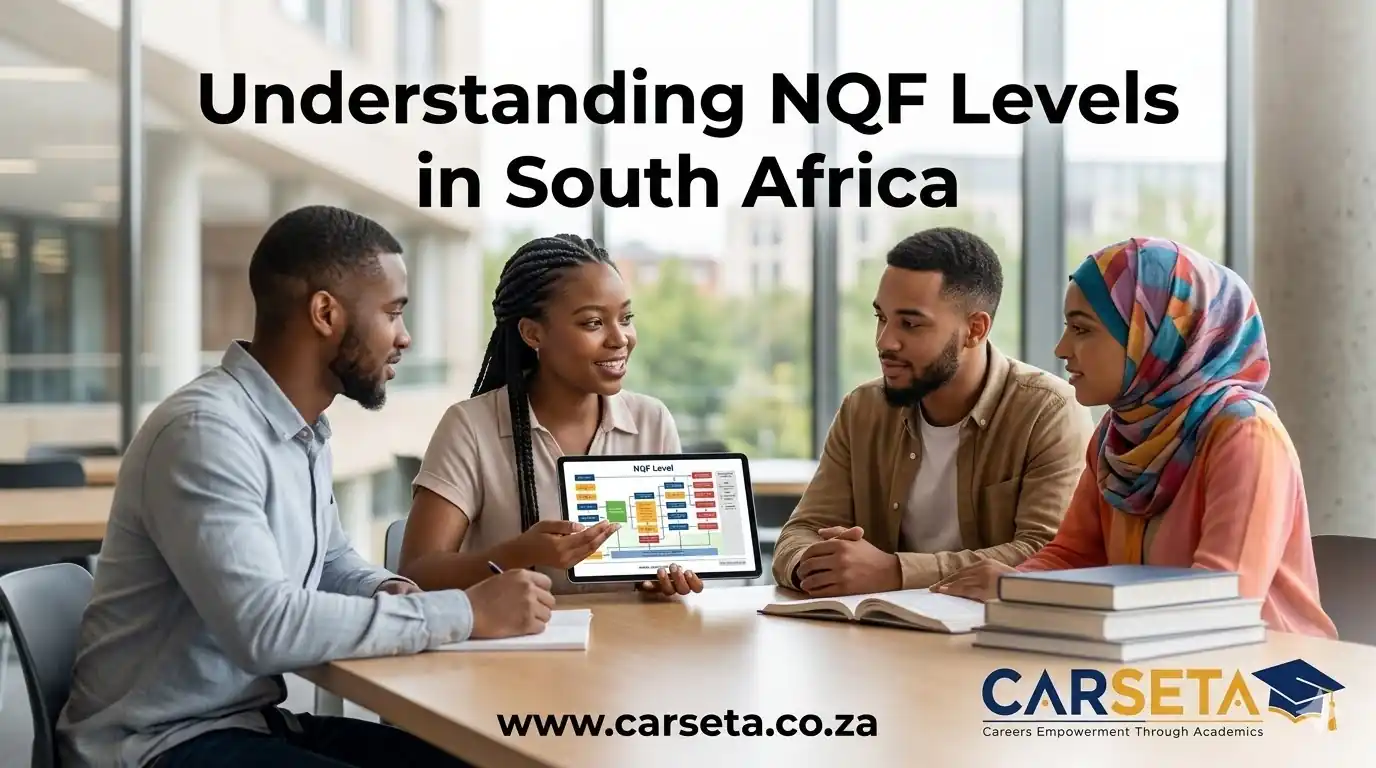
If you have ever applied for a learnership, internship, apprenticeship, bursary, or university programme in South Africa, you have probably seen a requirement such as “NQF Level 4” or “NQF Level 6.” While these terms appear on thousands of application forms every year, many people are still unsure what they actually mean.
Understanding the National Qualifications Framework (NQF) can help you make informed education and career decisions. Whether you are leaving school, studying at a TVET college, attending university, or looking for work, knowing how the NQF works allows you to identify qualifications that match your goals and understand the opportunities available at each level.
This guide explains the NQF in simple language, outlines all ten qualification levels, and shows how each level fits into South Africa’s education and skills development system.
What Is the National Qualifications Framework (NQF)?
The National Qualifications Framework (NQF) is South Africa’s official system for classifying qualifications according to their complexity and learning outcomes. It creates a common standard so that qualifications earned at schools, TVET colleges, universities, and training providers can be compared and recognised.
The framework was introduced to improve access to education, support lifelong learning, and ensure that qualifications are meaningful to employers and educational institutions.
Instead of viewing qualifications as isolated achievements, the NQF creates a learning pathway that allows learners to progress from basic education to advanced academic and professional qualifications.
Why Was the NQF Created?
Before the NQF existed, comparing qualifications from different institutions was often difficult. Learners also found it challenging to move between different education sectors.
The NQF was developed to:
- Create nationally recognised qualifications
- Improve the quality of education and training
- Support career development
- Encourage lifelong learning
- Make it easier for employers to understand applicants’ qualifications
- Help students move from one qualification to another
Today, almost every recognised qualification in South Africa is assigned an NQF level.
Who Oversees the NQF?
The National Qualifications Framework is overseen by the South African Qualifications Authority (SAQA). SAQA works with education quality councils to ensure qualifications meet national standards and remain relevant to the country’s skills needs.
Different quality councils oversee qualifications in various sectors, including:
- General and Further Education
- Higher Education
- Occupational and vocational qualifications
Together, these organisations help maintain confidence in South African qualifications.
Why Are NQF Levels Important?
Knowing your NQF level helps you understand where you are in your education journey and what opportunities you can pursue next.
Many employers use NQF levels when advertising jobs because they provide a consistent way of measuring educational achievement. Universities and colleges also use them to determine admission requirements.
For example, a learnership may require applicants to have an NQF Level 4 qualification, while a postgraduate diploma may require an NQF Level 7 qualification.
Understanding these requirements helps applicants avoid applying for programmes they do not yet qualify for.
Understanding the Ten NQF Levels
The National Qualifications Framework consists of ten levels. As the levels increase, qualifications become more advanced and require deeper knowledge, greater responsibility, and stronger analytical skills.
NQF Level 1
Level 1 is the starting point of the framework.
It generally represents:
- Grade 9 or Adult Education qualifications
- Foundation learning
- Basic literacy and numeracy skills
Many entry-level occupational training programmes begin at this level.
NQF Level 2
Level 2 represents education equivalent to Grade 10.
Learners continue developing practical knowledge while strengthening communication, mathematics, and workplace skills.
Some entry-level vocational programmes are offered at this level.
NQF Level 3
Level 3 is generally equivalent to Grade 11.
Learners gain broader theoretical knowledge while preparing for higher qualifications or workplace training.
Some occupational certificates are classified at this level.
NQF Level 4
Level 4 is one of the most recognised qualification levels in South Africa.
It usually includes:
- National Senior Certificate (Matric)
- National Certificate (Vocational) Level 4
- Equivalent occupational qualifications
Many learnerships, apprenticeships, internships, and entry-level jobs require applicants to have completed NQF Level 4.
For many South Africans, completing Level 4 opens the door to further study, workplace training, and career opportunities.
NQF Level 5
Level 5 marks the transition into higher education or specialised occupational learning.
Qualifications may include:
- Higher Certificates
- Advanced occupational certificates
- Some technical qualifications
Students at this level begin acquiring specialised knowledge in a particular field rather than general education.
Level 5 qualifications are valuable for individuals who want practical skills that prepare them for employment while also creating pathways to diploma studies.
NQF Level 6
Level 6 qualifications demonstrate a deeper understanding of specialised subjects.
Common qualifications include:
- Diplomas
- Advanced Certificates
Graduates often qualify for supervisory, technical, or professional support roles in industries such as engineering, business, healthcare, information technology, logistics, tourism, and education.
Many TVET graduates continue their studies from Level 6 into bachelor’s degree programmes where articulation agreements exist.
NQF Level 7
Level 7 is generally associated with a Bachelor’s Degree.
Students develop advanced theoretical knowledge together with research, analytical, communication, and problem-solving skills.
Graduates often pursue careers in:
- Accounting
- Engineering
- Information Technology
- Teaching
- Human Resources
- Marketing
- Public Administration
- Environmental Sciences
Many graduate internship programmes require applicants to hold an NQF Level 7 qualification.
NQF Level 8
Level 8 includes:
- Honours Degrees
- Professional Bachelor’s Degrees
- Postgraduate Diplomas
These qualifications build advanced expertise in a specialised discipline.
Learners often complete independent research projects while developing leadership and professional decision-making skills.
Many regulated professions require qualifications at this level before professional registration.
NQF Level 9
Level 9 represents Master’s Degrees.
Students conduct substantial independent research that contributes to knowledge within their academic or professional field.
Graduates frequently move into senior leadership, consulting, policy development, university teaching, or specialised professional practice.
NQF Level 10
Level 10 is the highest qualification level within South Africa’s education system.
It represents Doctoral Degrees.
Doctoral candidates undertake original research that advances knowledge in their discipline and contributes new ideas, discoveries, or innovations.
Many researchers, professors, scientists, and senior specialists hold qualifications at this level.
How NQF Levels Support Career Growth
The NQF is designed to encourage lifelong learning rather than viewing education as a once-off achievement.
A learner may follow a pathway such as:
- Complete Grade 12 (NQF Level 4)
- Obtain a Higher Certificate (Level 5)
- Earn a Diploma (Level 6)
- Complete a Bachelor’s Degree (Level 7)
- Continue with Honours (Level 8)
- Study for a Master’s Degree (Level 9)
- Achieve a Doctorate (Level 10)
Others may choose occupational qualifications, apprenticeships, or learnerships that lead directly into employment while still allowing future educational progression.
Useful Resources
To better understand the National Qualifications Framework (NQF) and verify qualification information, readers should refer to official South African education authorities. The South African Qualifications Authority (SAQA) maintains the National Qualifications Framework and provides tools to verify registered qualifications, compare qualification levels, and access information about the South African education system. Visit https://www.saqa.org.za/ for official guidance.
If you are planning to study at a university, TVET college, or participate in a learnership or skills programme, the Department of Higher Education and Training (DHET) offers information on education policies, institutions, funding initiatives, and skills development programmes. Learn more at https://www.dhet.gov.za/.
For those interested in occupational qualifications, apprenticeships, and workplace training, the Quality Council for Trades and Occupations (QCTO) provides information on occupational qualifications, accreditation, and assessment standards. Visit https://www.qcto.org.za/.
If you are looking for SETA-funded learnerships, skills programmes, and bursaries, you can also explore the websites of the relevant Sector Education and Training Authorities (SETAs), where current training opportunities and funding programmes are published.
These official references help readers verify information directly from the responsible authorities and improve the credibility and trustworthiness of your article.
Common Misconceptions About NQF Levels
One common misunderstanding is that a higher NQF level automatically guarantees employment. While qualifications improve career opportunities, employers also consider practical experience, technical skills, communication, teamwork, and problem-solving abilities.
Another misconception is that only university qualifications are valuable. In reality, occupational qualifications, apprenticeships, and TVET programmes produce highly skilled professionals who are essential to South Africa’s economy.
Finally, some people believe education stops after obtaining one qualification. The NQF encourages continuous learning, allowing individuals to improve their qualifications throughout their careers.
Tips for Choosing the Right Qualification
Before enrolling in any course, consider the following:
- Confirm that the qualification is nationally recognised.
- Ensure it matches your career goals.
- Check the entry requirements carefully.
- Understand which NQF level you will achieve upon completion.
- Explore opportunities for further study after graduating.
Making informed decisions today can create better opportunities in the future.
Frequently Asked Questions
Is Matric an NQF Level?
Yes. The National Senior Certificate (Matric) is generally classified as NQF Level 4.
Can I Study Further After a Learnership?
Yes. Many learnerships lead to recognised occupational qualifications that may create pathways to higher qualifications, depending on admission requirements.
Are TVET Qualifications Recognised?
Yes. Registered TVET qualifications that meet national standards are recognised within the National Qualifications Framework.
Do Employers Consider NQF Levels?
Yes. Many employers use NQF levels when setting minimum educational requirements for vacancies, internships, graduate programmes, and learnerships.
Final Thoughts
Understanding the National Qualifications Framework is essential for anyone planning a career or further education in South Africa. Rather than simply representing numbers, NQF levels provide a clear roadmap for lifelong learning, skills development, and professional growth.
Whether you are completing school, applying for a learnership, studying at a TVET college, or pursuing a university degree, knowing your NQF level helps you understand your current position and the opportunities available for the next step in your journey. By making informed education choices and continuously developing your skills, you place yourself in a stronger position to achieve your personal and career goals.

Mukhwthwa Maumela is passionate about empowering South Africans with reliable, verified, and easily accessible information about careers and education. Through https://www.carseta.co.za/ , Mukhethwa’s mission is to support students, job seekers, and young professionals by providing accurate guidance on learnerships, internships, bursaries, scholarships, and educational resources. you can get in contact with Mukhethwa throuth our email inquire@carseta.co.za